
THE BUILDING PRODUCT E-BULLETIN
THE BUILDING PRODUCT E-BULLETIN
03 February 2026

Unit 2, Ackhurst Road , Common Bank Industrial Estate, Chorley, Lancashire , PR7 1NH
T: 01257 266696
E: Sales@nccstreetscape.co.uk
W: https://nccstreetscape.co.uk
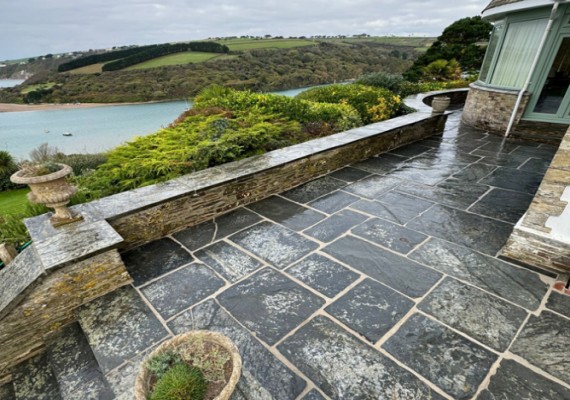
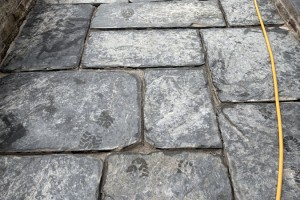
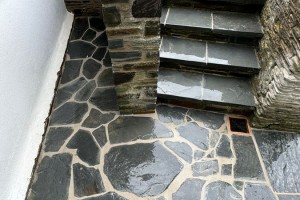
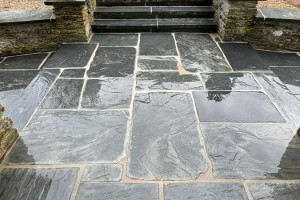
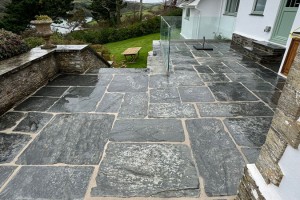
This prestige holiday home overlooks the beautiful River Avon estuary in South Devon, and it underwent a major refurbishment in 2018, including repointing the extensive original natural slate pathways, patios and terraces, which were repointed using traditional cement-based pointing by the builders. Unfortunately, this feature paving continued to need more repairs and repointing in some areas every year, to the extent that by summer 2025, it was also becoming unsightly, with the patches and more areas of cracked, failing pointing, breaking up in the joints. As well as unsightly, it had also become dangerous and was potentially a hazard for guests, so the owners turned to Gorah Stone, specialist stone restoration contractors, and asked them for a more durable and permanent solution. This original slate paving was laid with random sized, shaped, and thickness of slate slabs, and the work had to be done quickly in October 2025, with a high risk of wet conditions in this exposed coastal location, which together presented several critical issues for successful paving jointing:
To find a solution for all these issues, Gorah Stone contacted NCC Streetscape, the leading paving jointing specialists, for expert advice and fortunately, they had the answer. This was to use GftK vdw 850 plus, a unique, 2nd-generation, epoxy jointing mortar, which is reaction hardening, free of physical shrinkage, and the only truly wet-weather paving jointing. Variable joint dimensions are therefore also no problem, and it can be used in wet conditions, even in the rain! NCC Streetscape’s Technical Service manager also arranged to support Gorah on site with their first use of GftK vdw 850 plus, and they quickly and efficiently completed all the necessary preparation and repointing, despite the weather, and it is now good for many years to come.
Visit our Specialist Paving Jointing and Paving Repointing pages:
All things Paving Jointing:
https://nccstreetscape.co.uk/paving-jointing.html
All things GftK vdw 850 plus:
https://www.nccstreetscape.co.uk/paving-jointing/vdw-850plus.html
Paving Repointing:
https://nccstreetscape.co.uk/type-of-area/paving-repointing.html
View Previous Article
Harnessing the power of pedestals for hard landscaping

TSP Media
Grosvenor House
Central Park
Telford
TF2 9TW