
THE BUILDING PRODUCT E-BULLETIN
THE BUILDING PRODUCT E-BULLETIN
16 April 2026

Unit 56, Youngs Industrial Estate, Aldermaston, Berkshire, RG7 4PW
T: 0118 982 1555
E: karen@pumptechnology.co.uk
W: https://www.jung-pumps.co.uk/
Matt Camille, Projects Support Manager at Pump Technology Ltd, outlines the key factors specifiers should address when gravity drainage is not an option.
Modern building design regularly places drainage demands that gravity alone cannot meet. Basement facilities, sub-floor plant rooms, commercial kitchens positioned below the site drainage invert, and deep refurbishment projects all present the same fundamental challenge: wastewater needs to go somewhere, and it cannot flow uphill without mechanical assistance.
For specifiers, the decision to incorporate a pumped drainage system is rarely the problem. Getting the specification right at design stage — before the contractor is on site — is where the real value is added.
1. Tank capacity against peak inflow
Sizing a collection tank against average daily flow is one of the most common specification errors. Peak demand periods — breakfast service in a hotel, shift changes in a commercial facility, morning routines in a residential block — generate far higher inflows than daily averages suggest. An undersized tank leads to frequent pump cycling, accelerated wear, and early component failure. Confirm peak inflow rates before selecting tank capacity.
2. Duty point verification
A pump's performance curve must be matched to the actual calculated duty point of the installation — total head, flow rate, and pipe losses included. This verification step is too important to defer to the installer on site. Submitting a correctly verified performance curve at specification stage removes ambiguity and reduces the risk of an incorrectly selected unit reaching the project.
3. Redundancy on commercial applications
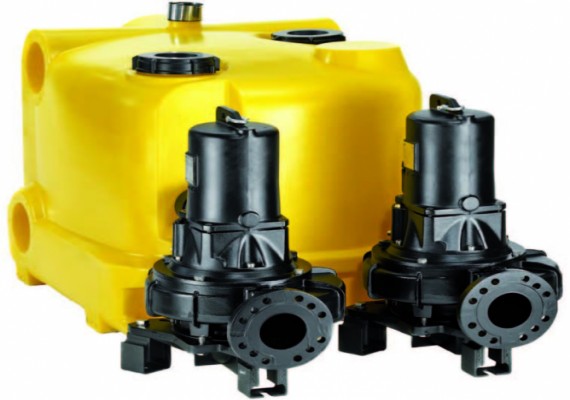
A single-pump configuration has one critical weakness: if it fails, drainage stops. On commercial sites — restaurants, hotels, office buildings — the consequences of a drainage failure extend well beyond inconvenience. A duty/standby pump arrangement is standard practice for any application where continuity of drainage is operationally essential, and should be specified accordingly.
4. Isolation valve placement
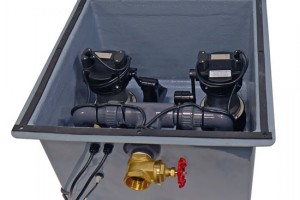
Maintenance access is frequently overlooked at design stage. Fitting isolation valves on both the inlet and discharge side of each pump allows for removal and servicing without draining the entire station. Mark valve positions clearly on technical drawings to assist maintenance teams and support long-term compliance.
Pump Technology Ltd is the UK's authorised distributor for Pentair Jung Pumpen wastewater and sewage pumping systems, offering full specification support for pumped drainage applications — including duty point calculations, product selection, and technical data packages for public health engineers and M&E consultants.
For specification support, visit jung-pumps.co.uk or contact Matt Camille directly at matt@pumptechnology.co.uk.
Images:
DrainKing Wastewater pumping system using dual pumps.
Jung Pumpen Compli 2500 twin pump sewage pumping station

TSP Media
Grosvenor House
Central Park
Telford
TF2 9TW